
Social Media Ethics For Small Businesses: Why Honest Marketing Beats Clever Marketing Every Time
I have been running Three Girls Media for more than 22 years. In that time, I have watched social media go from a curiosity my clients asked about a little sheepishly to the front door of almost every business I work with. Something else changed along the way, and it is the part nobody puts on a pitch deck.
The Stakes
When your entire marketing presence was a Yellow Pages ad and a decent handshake, a fib was between you and one customer. Now a single poorly considered post can be screenshotted, quote-tweeted, stitched, duetted, and dissected by people who have never bought anything from you and never will. That is the bad news. The good news, and I promise there is quite a lot of it, is that the businesses playing this honestly are winning. Not in a warm fuzzy karma sense, but in a measurable, revenue-attached, customers-keep-coming-back sense.
So let us talk about social media ethics. Not the version that reads like a compliance memo written by someone who has never actually posted anything, but the practical version. What goes wrong, what it costs you, and what to write instead.
What Social Media Ethics Actually Means (No Philosophy Degree Required)
Social media ethics is not a leather-bound code of conduct. At its core, it is four commitments.
- Honesty. What you say about your service or product, your results, your reviews, and your reach is true.
- Transparency. When money, free product, or a relationship influenced a post, the audience knows.
- Respect. For your customers’ privacy, for other creators’ work, and for your competitors’ dignity.
- Accountability. When you get it wrong, you own it publicly instead of quietly deleting the post and hoping nobody kept the receipts. Someone always keeps the receipts.
That’s it. Four things. If you can hold those four in your head while you write a caption, you are ahead of a startling percentage of brands out there.
Why Small Businesses Actually Have More To Lose Than The Big Guys
I hear a comforting assumption a lot: ethics scandals are a big brand problem. Nobody is scrutinizing a 12-person accounting firm in Olympia, Washington, the way they scrutinize a Fortune 500.
I understand the logic, but I think it’s backward.
A national brand that fumbles has a crisis communications team, a legal department, a media budget and enough brand equity to absorb a bad week. You have you. Maybe you plus a part-time marketing coordinator who is also handling the newsletter and the trade show booth.
More importantly, your reputation is local, personal, and durable. When a national brand messes up, people are annoyed for a news cycle. When a local business messes up, people remember at the school pickup line for six years. Your customers know your name; they know your kids’ names. Trust isn’t an abstraction in a small market; itis a real asset.
And in case you were wondering, the Federal Trade Commission does not have a small business exemption. Disclosure rules around endorsements, testimonials and sponsored content apply to a solo consultant with 400 followers exactly as they apply to a global beverage company. The FTC revised the Endorsement Guides in 2023, and the agency’s final rule banning fake reviews and testimonials took effect in October 2024. That rule covers reviews written by people who don’t exist, including AI-generated ones, as well as reviews quietly solicited from your own staff. Penalties can reach tens of thousands of dollars per violation.
Nobody is coming after you for an honest mistake. But “we did not know” is a rough place to be standing.
Eight Ethical Social Media Slip-Ups I See Constantly, And What To Write Instead
Here is where this article gets useful. Every example below is invented, but each one is a composite of something I have genuinely seen in the wild. I changed names to protect the well-meaning.
1. Manufactured Urgency
The post that gets you in trouble:
🚨 FINAL 3 SPOTS LEFT for our spring coaching program!! Cart closes at midnight and we will NOT be reopening enrollment this year. Do not miss out!!
Then the cart reopens on Thursday. And again in April. And there were never three spots; there was a Google Form with unlimited capacity.
The post that builds trust:
Spring coaching enrollment closes Friday at midnight. We cap each cohort at 12 so everyone gets real one-on-one time, and we are at 9 right now. If the timing is wrong for you this round, our next cohort opens in September and I will happily put you on the early list.
Why the rewrite works: The second version still has urgency. The difference is that the urgency is real and the reason for it is explained. You get the conversion without training your audience to ignore you. Fake scarcity is a loan against your credibility, and the interest rate is brutal.
2. The Undisclosed Partnership
The post that gets you in trouble:
Obsessed with this new project management tool. Cut our team’s admin time in half. Link in bio!
The link is an affiliate link, and there is no disclosure anywhere.
The post that builds trust:
Obsessed with this project management tool. It cut our team’s admin time roughly in half over the last quarter. Full transparency, we are an affiliate, so if you sign up through our link, we earn a commission. We only recommend software we actually use, and we have turned down three partnerships this year for exactly that reason. Link in bio.
Why the rewrite works: Disclosure is not a confession. Framed well, it is a credibility builder. Telling people you have turned down partnerships says more about your judgment than any five-star review could. Put the disclosure at the top where people actually read, not buried under nine hashtags. The FTC’s Disclosures 101 for Social Media Influencers is short, plain English and worth forwarding to anyone who posts on your behalf.
3. The Mystery Testimonial
The post that gets you in trouble:
“Working with this team changed my business forever. Revenue up 400% in 60 days!” ⭐⭐⭐⭐⭐
Just another happy client 😊
No name, no company, no context. Because it came from a brainstorming session about what a happy client might theoretically say.
The post that builds trust:
“My inbound leads went from 4 a month to 11 a month over our first quarter working together with Three Girls Media. That is not magic; it is just consistency I could not maintain on my own.” Dana Whitfield, owner of Whitfield Bookkeeping, Tacoma.
Results vary widely depending on industry and starting point. Dana already had a strong referral base, and we built on it.
Why the rewrite works: A specific, modest, and verifiable claim from a named human beats a spectacular anonymous one by a mile. Nobody believes 400% in 60 days anyway. They believe 4 to 11. Edelman’s 2026 research on brand growth found that what people who are not paid by a brand say about it carries far more weight than anything the brand says about itself, with unpaid advocates and actual customers at the top of the list. Also, if you use a testimonial, get written permission, keep it on file and do not edit it into something the person never said.
4. Borrowed Content
The post that gets you in trouble:

[Beautiful photograph of a misty forest trail, pulled from a Google image search, no credit, cropped to remove the watermark]
The post that builds trust:
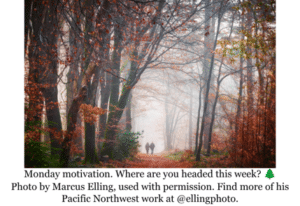
Why the rewrite works: Because the first version is copyright infringement with a nature filter. Cropping out a watermark is not a gray area; it is intent. And before you reach for the fair use defense, the Copyright Office is blunt in its fair use FAQ: there is no magic number of words or percentage of an image that is automatically safe. Their Fair Use Index is a searchable database of how courts have actually ruled, and it is sobering reading. Use licensed stock, use your own photos, use images you have explicit permission for and credit the creator by name. This applies to memes, graphics, quotes and yes, that infographic you found on Pinterest with no source on it.
5. The AI Ghostwritten Personal Story
The post that gets you in trouble:
I will never forget the moment my mentor pulled me aside in 2009 and said something that changed my entire approach to leadership…
There was no mentor. There was no 2009. There was a ChatGPT prompt that said, “write me an emotional LinkedIn post about leadership.”
The post that builds trust:
Something I have been chewing on about leadership: the managers I learned the most from were the ones who told me quickly when I was wrong, not kindly. It stung. It also saved me months. Curious whether that matches your experience or whether you had the opposite.
Why the rewrite works: I want to be clear: I have zero problem with AI as a drafting and editing tool. We use it. The line is fabricated personal experience presented as lived truth. Your audience is getting very good at spotting invented origin stories, and the moment they catch one, they will reread every previous post wondering what else was made up. Use the tool. Do not let it invent your life.
6. Customer Privacy
The post that gets you in trouble:

Look at this transformation!! 😍 Julie came in so nervous and left GLOWING. Ask her about the eyebrows!!
Julie did not know this was going up.
The post that builds trust:
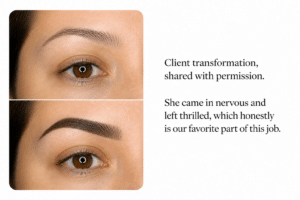
Why the rewrite works: Get written consent before posting, every time, for every photo, and a clear option to say no without any awkwardness. This is not just an aesthetics industry issue. It applies to law firms, therapists, financial advisors, veterinarians, contractors photographing the inside of someone’s home and anyone posting a photo of a customer’s face, kid, house number or license plate. When in doubt, blur it or skip it.
7. The Competitor Swipe
The post that gets you in trouble:
Unlike SOME agencies in town 👀 we actually answer our phones. Just saying. If your current provider ghosted you again this week, you know where to find us. 💅
The post that builds trust:
Here is our promise: you get a response within one business day, every time, from an actual person who knows your account. If that is not what you are getting right now, it is worth a conversation.
Why the rewrite works: Same message. One version makes you look confident; the other makes you look like you have a grudge. Subtweeting a competitor (posting about someone without naming or tagging them, in a way that makes the target obvious to anyone with context but leaves you technically deniable) tells prospects exactly how you will talk about them if things go sideways. Compete on what you do well and let the comparison make itself.
8. Newsjacking A Tragedy
The post that gets you in trouble:
Our hearts go out to everyone affected by the wildfires. 💔 In times like these, protecting what matters most is everything. That is why we are offering 20% off all home security packages this week with code SAFETY20.
The post that builds trust:
Our hearts are with everyone affected by the fires. We are donating $2,000 to the county relief fund and matching employee contributions through the end of the month. No promo, no code, no ask. If you need help and cannot pay right now, message us anyway and we will figure something out.
Why the rewrite works: If you are going to show up during a crisis, show up without the discount code attached. There is a version of corporate compassion that is genuinely welcome and a version that reads like a vulture in a cardigan. The difference is whether the post includes an ask. Also, and this is the practical part, turn off your scheduled posts during a local or national crisis. A cheerful automated caption dropping into a grieving feed is a completely avoidable unforced error.
Building A Social Media Ethics Policy You Will Actually Use
Most policies fail because they are 14 pages long and live in a shared drive nobody has opened since onboarding. Yours should fit on one page and cover five things.
- Who approves what. Name the human who signs off on anything touching a claim, a client, a crisis or a controversy. One name, not a committee.
- Your disclosure standard. Write down exactly how you disclose sponsorships, affiliate links, gifted products and employee-authored reviews. Use the same boilerplate language every time so nobody has to improvise at 4:55 pm on a Friday.
- Your sourcing rules. Where images come from, how creators get credited, how statistics get verified, and what your standard is for citing a source. If you cannot find the original study, do not post the statistic.
- Your consent process. How you get permission for customer photos, testimonials and stories, where that permission is stored and how someone revokes it later.
- Your correction protocol. Decide now, while you are calm, what you do when you get something wrong. My recommendation: correct it in a new post rather than a silent edit, acknowledge the error plainly, skip the defensive explanation and move on. People forgive mistakes remarkably fast. They do not forgive the cover-up.
The Three Question Gut Check
When something feels slightly off, and you cannot articulate why, run it through these:
- Is every factual claim in this post true and could I prove it?
- Does this post rely on the reader not knowing something? If the persuasive power evaporates the moment they learn the full context, that is not persuasion; that’s a trick.
- Would I be comfortable if the person this post is about read it? The competitor, the client, the customer in the photo.
If any answer is shaky, the post is not ready. That hesitation you feel isn’t writer’s block; it is your judgment doing its job.
Social Media Ethics Is A Long Game, And Small Businesses Are Built For Long Games
Here’s what took me a couple of decades to fully appreciate. The unethical version of a post usually does outperform the ethical version. In the short term. Fake urgency converts; outrage gets reach. The anonymous 400% testimonial gets more saves than Dana’s honest 4 to 11.
But you are not running a campaign; you are running a business, and businesses run on repeat customers and referrals. The audience is enormous, which is exactly the problem. Pew Research Center puts YouTube use among American adults at 84% and Facebook at 71%, so the room you are standing in isn’t small, and it doesn’t forget. Every shortcut costs a little trust to buy a little attention. Do it often enough and you end up with an audience that is large, engaged and entirely unwilling to buy anything from you.
The alternative is slower and considerably more durable. You become the business people describe to their friends as “they are really straight with you.” That sentence is worth more than any ad spend I could recommend.
Twenty-two years in, my honest assessment is that ethical social media is not a constraint on good marketing. It is the constraint that makes marketing good. Take away the option to exaggerate and you are forced to get specific, and specific is what actually persuades people.
Wondering whether your social media presence would hold up to a trust audit? Our social media management and content writing clients work directly with me from day one, not a junior team member learning on your account. Let us take a look together.